The SEO vs GEO debate is about one question: when an AI tool writes the answer, does it name your business? Search engine optimisation is the practice of earning a place in a search engine's ranked results. Generative Engine Optimisation is the practice of getting your brand cited and described correctly inside answers written by AI tools such as ChatGPT, Perplexity and Google AI Overviews.
In Dubai, the two are less separate than agency pitches suggest. This guide sets out what actually changes, and what GoupSEO fixes first on client sites.
SEO vs GEO: what is the difference?
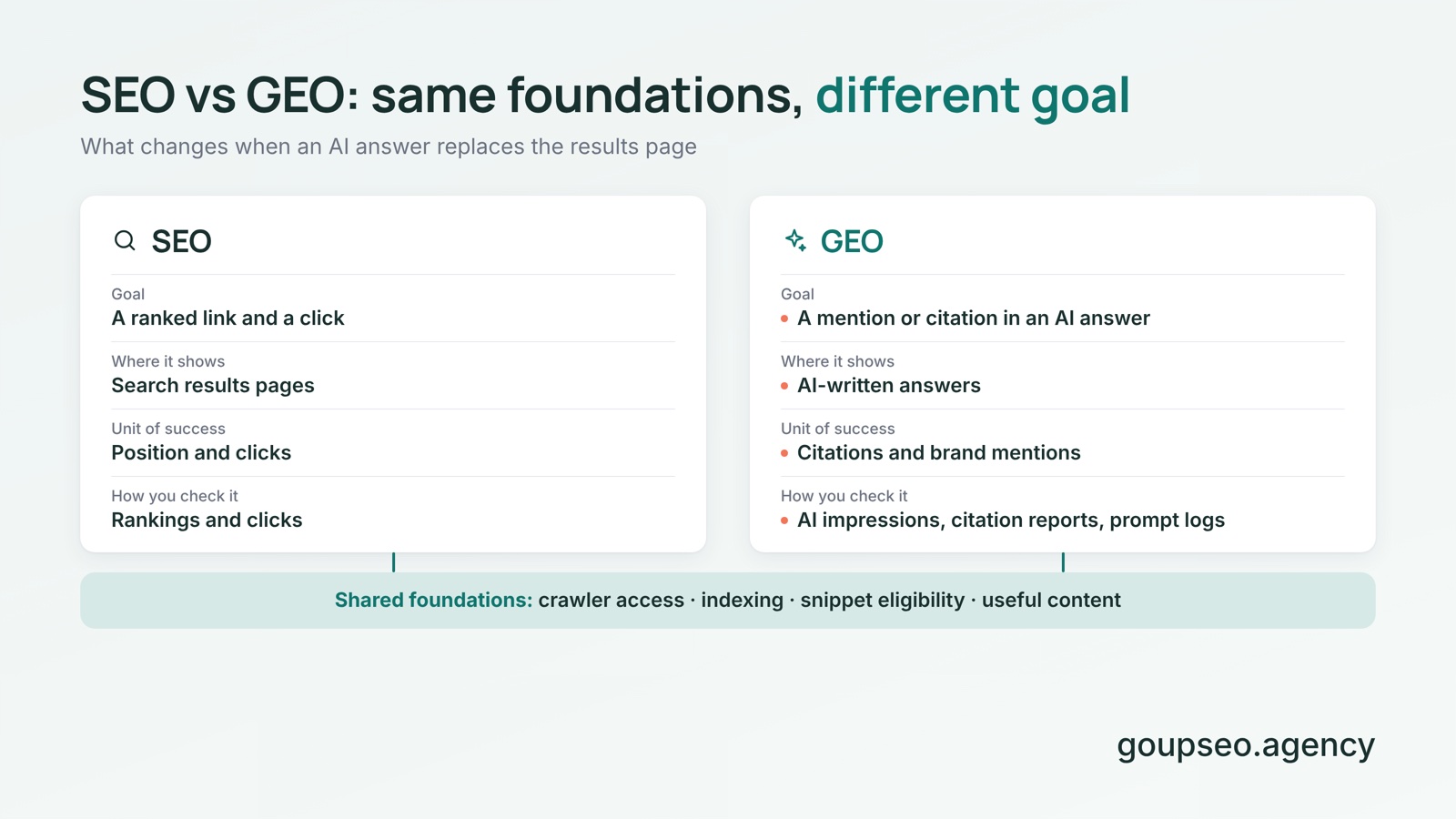
In the GEO vs SEO comparison, SEO aims to rank a page so a searcher clicks it. GEO aims to have an AI answer cite or recommend your brand, often without a click. The foundations overlap heavily. What differs is the goal, and how you measure it.
The term "generative engine optimization" comes from a 2023 research paper by Pranjal Aggarwal and colleagues, later accepted to the KDD 2024 conference. In that study, the authors found that GEO methods can boost visibility by up to 40% in generative engine responses. That figure comes from a research test, not from live business sites, so treat it as proof that content matters rather than a forecast.
Answer Engine Optimisation (AEO) sits between the two. AEO is the practice of shaping a page so a search engine or assistant can lift it as the direct answer to one question, such as a featured snippet. In the SEO vs AEO comparison, AEO is the narrower job: one question, one answer.
LLM SEO, meaning SEO aimed at large language models (LLMs, the AI systems behind ChatGPT and Gemini), is a common umbrella term for both.
| SEO | AEO | GEO | |
|---|---|---|---|
| Main goal | A ranked link and a click | The direct answer to one question | A mention or citation in an AI answer |
| Main surfaces | Google and Bing results | Featured snippets, AI Overviews | AI Overviews, AI Mode, ChatGPT search, Perplexity, Copilot |
| Unit of success | Position and clicks | The answer box | A citation or brand mention |
| How you check it | Rankings and clicks | Search the question | AI feature impressions, citation reports, prompt logs |
Source: how GoupSEO separates SEO, AEO and GEO in client work.
Is GEO replacing SEO?
No. Google's own documentation treats GEO as part of SEO, and Microsoft has built GEO reporting into its existing Bing webmaster tools. GEO adds checks on top of SEO. It does not replace the crawling and indexing work that decides whether a page is used at all.
Google published its new guide to optimising for generative AI features on 15 May 2026. The guide names AEO and GEO as terms "you may see used". It then says that, from Google Search's perspective, optimising for generative AI search is "still SEO". Google's reason is that its generative AI features are rooted in its core Search ranking and quality systems.
Microsoft described its AI Performance report in Bing Webmaster Tools in February 2026 as an early step toward GEO tooling.
So is SEO being phased out? Not on any evidence the platforms have published. Whether agencies call it GEO SEO or AI SEO, the new work sits on top: checking how AI tools describe your brand, and fixing the sources those answers draw on.
GoupSEO runs its AI search work as one programme built on classic SEO, because the same page has to rank and be quoted. GoupSEO's LLM SEO, GEO and AEO agency in Dubai service starts with an audit of how ChatGPT, Gemini, Perplexity and Google AI Overviews describe your brand today. You work directly with the founder, with no lock-in contract.
Why the SEO vs GEO question matters more in the UAE
The UAE uses generative AI more than any other country Microsoft measures, and Google's AI answers work there in both English and Arabic. For a UAE business, more buying questions now get an AI-written answer before anyone opens a website.
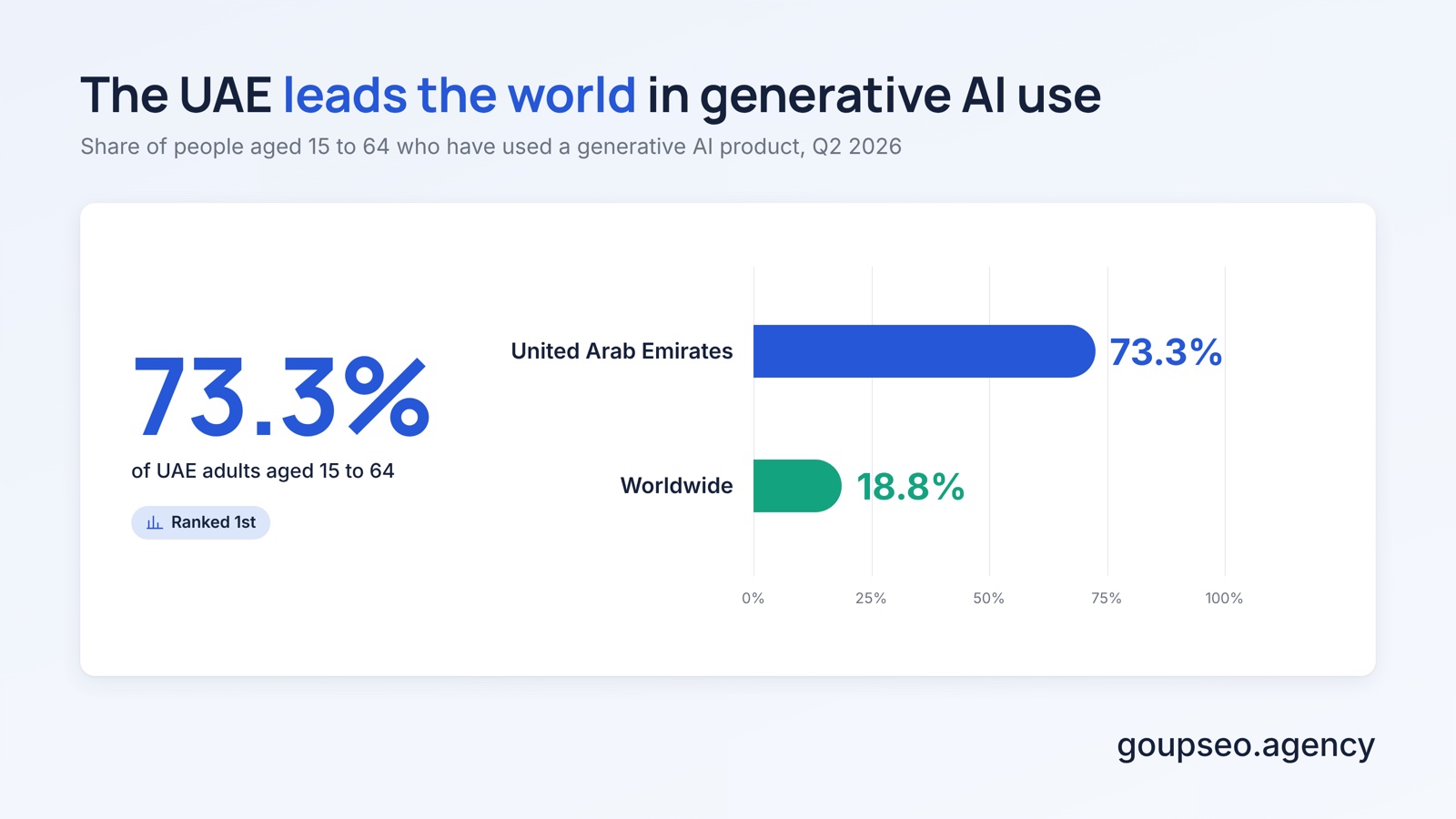
Microsoft's AI Economy Institute measures the share of people aged 15 to 64 who have used a generative AI product. Microsoft's September 2026 report put UAE usage at 73.3% in the second quarter of 2026, first on Microsoft's leaderboard, against 18.8% of the working-age population worldwide.
Google brought AI Overviews to the Middle East and North Africa, with Arabic support, on 20 May 2025. As of 23 November 2026, Google's AI Overviews help page lists the United Arab Emirates and Arabic.
Google AI Mode, the conversational tab in Google Search, began rolling out in Modern Standard Arabic on 8 October 2025. Google's AI Mode help page also lists the UAE and Arabic today.
"Queries in AI Mode are on average three times longer than traditional searches," Sundar Pichai, CEO of Google and Alphabet, said on 28 October 2026. Longer questions favour pages that answer specific situations.
What changes when the answer engine replaces the results page?
Three things change: fewer people click, one answer draws on many searches, and success is counted in citations rather than positions. For a marketing lead, that means reporting on whether AI answers name the brand, rather than on rankings and traffic alone.
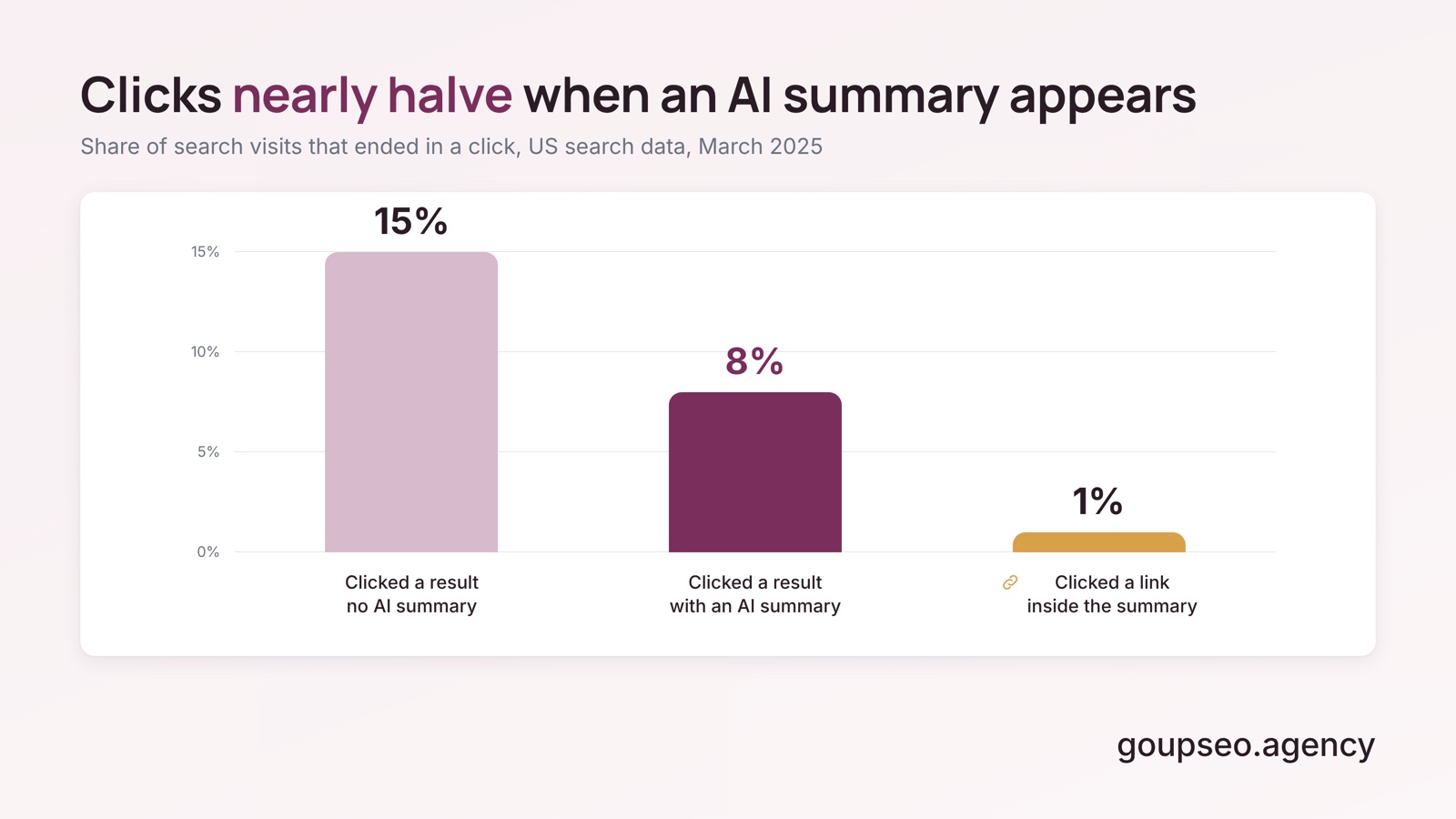
Fewer clicks. Pew Research Center tracked 900 US adults in March 2025. In Pew's data, users who saw a Google AI summary clicked a traditional result in 8% of visits, against 15% when no summary appeared. Pew found that users clicked a link inside the summary in just 1% of visits. This is US data. We have found no published UAE equivalent, so read it as a direction, not a Dubai forecast.
One answer, many searches. Google's guide describes query fan-out as "a set of concurrent, related queries" that the model generates to request more information. A page that answers one narrow sub-question well can be pulled into an answer even when it does not rank first for the main query.
A new unit of success. In classic SEO you report a position and a click. In GEO you report whether the answer named you, how it described you and which page it cited. In SEO vs GEO terms, a brand can lose clicks and still gain visibility, or rank well and be missing from the answer.
What stays the same: crawling, indexing and snippets
SEO foundations decide whether a page can appear in an AI answer at all. If a crawler cannot reach a page, or it is not indexed, no GEO work will get it cited.
Google says a page must be indexed and eligible to be shown with a snippet to appear as a supporting link in AI Overviews or AI Mode. A snippet is the short text preview under a search result. Blocking snippets therefore removes a page from these features.
ChatGPT and Perplexity use their own crawlers, the automated bots that fetch web pages. OpenAI says sites that opt out of OAI-SearchBot will not be shown in ChatGPT search answers, while GPTBot is a separate crawler for its foundation models. Perplexity says PerplexityBot surfaces and links websites in Perplexity results, and is not used to crawl content for foundation models.
A blanket block on AI bots can remove a site from these answers without any warning. GoupSEO's technical AI SEO services in Dubai check robots.txt rules and firewall settings for each of these bots.
Which GEO tactics does Google say you can skip?
Google's May 2026 guide lists several popular AI optimisation tactics that its generative AI search does not need. They include llms.txt files, content chunking, special schema and seeded brand mentions. Many GEO packages leave this part out.
| Common GEO advice | What Google's guide says |
|---|---|
| Add an llms.txt or other AI text file | No new machine-readable files, AI text files, markup or Markdown are needed |
| Break content into small chunks for AI | There is no requirement to break content into tiny pieces |
| Add special schema for AI | Structured data is not required, and there is no special schema.org markup to add |
| Seed brand mentions across the web | Seeking inauthentic mentions "isn't as helpful as it might seem" |
Source: Google Search Central, Optimizing your website for generative AI features on Google Search, updated 10 July 2026.
One limit: Google's list covers only Google. In the sources we checked, ChatGPT, Perplexity and Copilot have published no equivalent. Google's own advice is plain: content that people find unique and useful will likely shape your presence in its AI search more than any other suggestion in the guide.
How do you measure GEO alongside SEO?
You can now measure part of GEO with free tools. Google Search Console reports how often your pages appear in Google's AI features, and Bing Webmaster Tools reports how often Microsoft Copilot cites them. Neither lists clicks from those answers, so citation tracking still needs prompt tests.
| Tool | Surfaces covered | What it reports | What it does not report |
|---|---|---|---|
| Search Console, Generative AI report | AI Overviews, AI Mode, Discover | Impressions by page, country, device and date | Clicks or queries (none listed) |
| Bing Webmaster Tools, AI Performance | Copilot, Bing AI summaries, select partners | Citations, cited pages, grounding queries | Clicks (none listed) |
| Manual prompt log | ChatGPT, Gemini, Perplexity, Claude | Who is named and cited for your buying questions | Volume or traffic |
Sources: Google Search Central Blog, June 2026; Bing Webmaster Blog, February 2026.
Grounding queries are the searches an AI system ran to find the page it cited. Google launched its Generative AI performance reports on 3 June 2026 and says the reports reached all websites worldwide on 31 August 2026. Google's guide also notes that no third-party tool has access to its internal ranking or AI systems.
GoupSEO's engagement with a new B2B SaaS company in Germany shows what this data looks like in practice. In three months, the GoupSEO client reached 100K GenAI impressions in Search Console and 2,000+ organic clicks per month. The case study itself calls these figures proxies, because no tool reports how often a brand is cited for each prompt.
What a GoupSEO engagement with a Dubai business setup consultancy showed
In a 12-month engagement, GoupSEO doubled organic traffic and tripled leads for a business setup consultancy in Dubai, while the client's citations in ChatGPT, Gemini and Claude rose 1.5x. The work was mostly classic SEO, planned with AI answers in mind.
We built a closely matched service page for each valuable search and kept a steady publishing schedule on the questions founders ask after choosing Dubai. We earned links from local websites and mentions in UAE news outlets. We also launched pages in Arabic, Spanish, German, Russian and other languages, where competition was lighter than in English.
| Metric | Result | Note |
|---|---|---|
| Organic traffic | 2x | Verified in Ahrefs, per the case study |
| Leads | 3x | As published |
| LLM citations (ChatGPT, Gemini, Claude) | 1.5x | Labelled directional on the case study |
Source: GoupSEO verified case study, business setup consultancy in Dubai, 12-month engagement.
Citation counts are harder to verify than traffic, and the case study says so. More results by client type are in GoupSEO's AI search case studies.
A Monday-morning SEO and GEO plan for UAE teams
Start with crawler access and measurement before content. A marketing lead can check or brief each step this week, and sector detail sits on the industries GoupSEO works with page.
- Check robots.txt and firewall rules for OAI-SearchBot and PerplexityBot. A blocked bot cannot show your pages.
- Confirm key pages are indexed and allowed a snippet in Google Search.
- Turn on the reports you already have. Open the Generative AI report in Search Console and add your site to Bing Webmaster Tools.
- Write down 10 to 20 buying questions. Run them in ChatGPT, Gemini, Perplexity and Google every month, and log who is named.
- Put the answer in the first two sentences of every service page, then the detail.
- Publish Arabic pages for the services your customers search for in Arabic.
- Skip the shortcuts Google rules out, such as llms.txt files and special AI schema, unless another platform asks for them.
AI search features change quickly, often month to month. We last verified every platform claim in this article on 23 November 2026.
Frequently asked questions
Is GEO replacing SEO?
No. Google's May 2026 guide says optimising for its generative AI search is still SEO, because its AI features run on the same core ranking and quality systems. GEO adds new checks, such as how AI tools describe your brand, on top of the same crawling and content work.
What is the difference between AEO and GEO?
Answer Engine Optimisation (AEO) aims to make a page the direct answer to one question, such as a featured snippet. Generative Engine Optimisation (GEO) aims to get a brand named or cited inside an AI-written answer that draws on many sources. In practice, the same pages serve both.
Do you need an llms.txt file for AI search?
Not for Google. Google's guide says you do not need new machine-readable files, AI text files or special schema.org markup to appear in AI Overviews or AI Mode. Pages must be indexed and eligible for a snippet. Other platforms have published no equivalent rule in the sources we checked.
Can you measure GEO results in Search Console?
Partly. Since 31 August 2026, the Generative AI report in Search Console has been available to all websites. It shows impressions in AI Overviews, AI Mode and Discover AI features by page, country and device, but Google's announcement lists no clicks or queries. Bing Webmaster Tools reports citations in Microsoft Copilot.
Are Google AI Overviews available in the UAE and in Arabic?
Yes. Google's AI Overviews and AI Mode help pages both list the United Arab Emirates and Arabic, as checked on 23 November 2026. AI Overviews launched in the region with Arabic in May 2025, and AI Mode began rolling out in Modern Standard Arabic in October 2025.