How to optimise content for LLMs comes down to one test. Can ChatGPT, Gemini, Perplexity or Google AI Overviews find your page, understand it and quote it with your name attached? LLM optimisation is the practice of making website content easy for large language models (LLMs), the AI systems behind these tools, to find and cite in their answers.
Most of it is classic SEO done carefully. The rest is knowing which popular tactics do nothing, and this guide covers both for UAE sites.
How do you optimise content for LLMs?
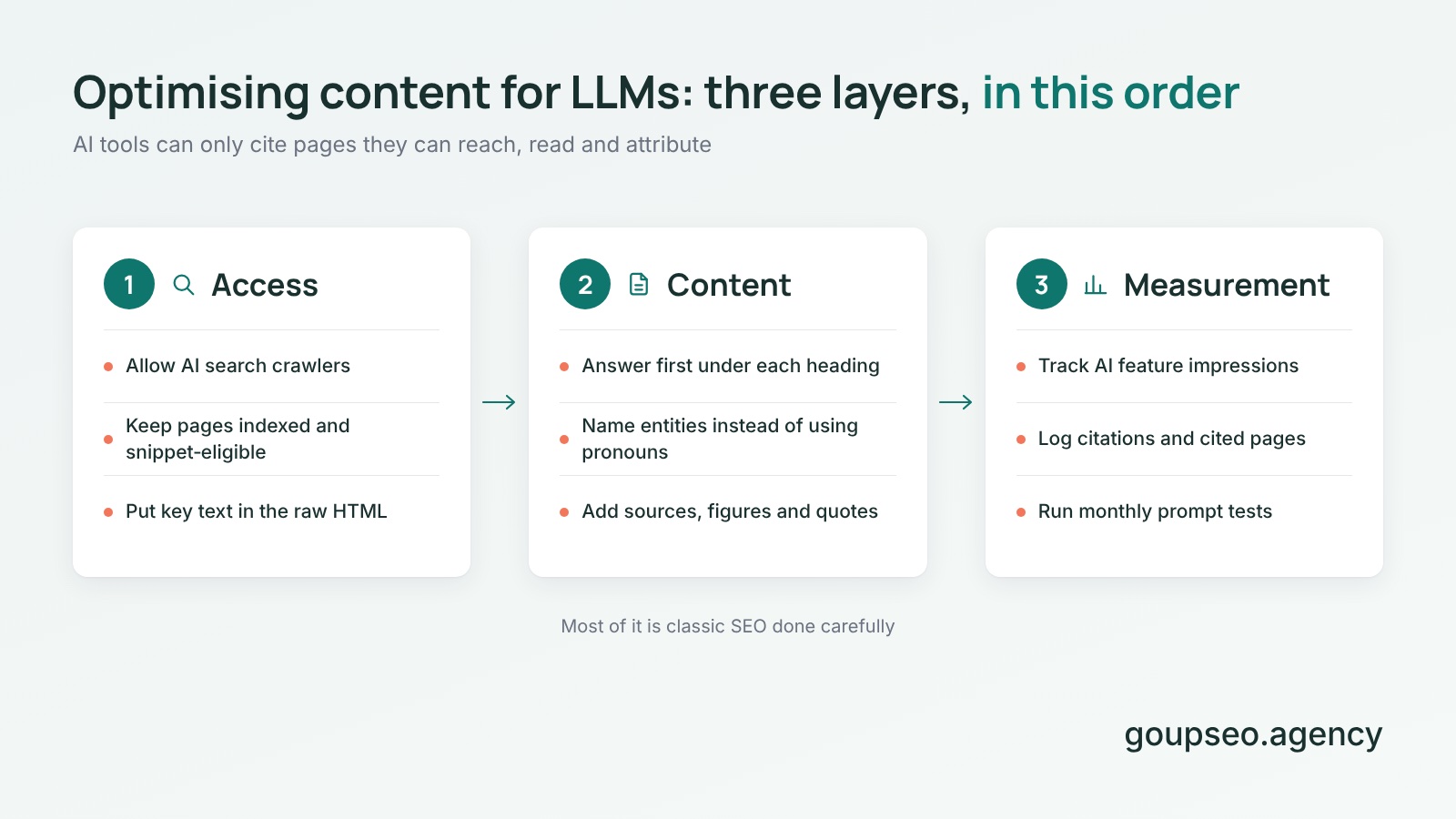
You optimise content for LLMs in three layers. First, let AI crawlers reach and index the page. Second, write each section so it answers one question with named evidence. Third, track whether AI answers cite you. Access problems do not show up in normal analytics, so every GoupSEO audit starts there.
LLM SEO is the common name for this work. Generative Engine Optimisation (GEO) aims for a citation inside an AI-written answer. Answer Engine Optimisation (AEO) aims to be the direct answer to one question.
According to Google's guide, optimising for generative AI search is optimising for the search experience, and "still SEO". The new work sits on top of classic SEO.
| Layer | What you do | Who documents it |
|---|---|---|
| Access | Allow search crawlers; keep pages indexed and snippet-eligible | Google, OpenAI, Perplexity, Anthropic |
| Content | Answer first; name entities; add sources, figures and quotes | Google, GEO research (KDD 2024) |
| Measurement | Track AI impressions, citations and prompt results | Google Search Console, Bing Webmaster Tools |
Source: GoupSEO's working model, built from the platform documentation cited in this article.
Can AI crawlers reach your pages?
An AI tool cannot cite a page it cannot reach. AI companies run separate crawlers for search and for model training. Blocking the wrong one can remove your site from AI answers without any warning, so check access before you rewrite anything.
For Google, a page must be indexed and eligible to be shown with a snippet to appear as a supporting link in AI Overviews or AI Mode. A snippet is the short text preview under a search result. Google lists no additional technical requirements.
The other platforms are controlled through robots.txt, the file that tells crawlers which pages they may visit. OpenAI says sites that opt out of OAI-SearchBot will not be shown in ChatGPT search answers. OpenAI adds that a robots.txt change takes about 24 hours to reach its search systems.
Perplexity says PerplexityBot surfaces and links websites in its search results and is not used to crawl content for foundation models. Anthropic says disabling Claude-SearchBot may reduce your visibility in Claude's search results.
| Crawler | Company | What it does | If you block it |
|---|---|---|---|
| OAI-SearchBot | OpenAI | Surfaces sites in ChatGPT search | Not shown in ChatGPT search answers |
| GPTBot | OpenAI | Collects training content | Content not used for training |
| PerplexityBot | Perplexity | Surfaces and links sites in Perplexity | Perplexity recommends allowing it to appear in results |
| Claude-SearchBot | Anthropic | Indexes content for Claude's search | May reduce visibility in Claude's search results |
| ClaudeBot | Anthropic | Collects training content | Future content excluded from training |
Source: OpenAI, Perplexity and Anthropic crawler documentation, checked 23 November 2026.
In GoupSEO audits, we look beyond robots.txt, because blocks can also come from content delivery network (CDN) bot settings and firewall rules. GoupSEO's technical AI SEO services in Dubai test each crawler against the live site. We also check that the main text is in the raw HTML, because a crawler that does not run JavaScript cannot see text loaded by scripts.
What does Google say you can skip?
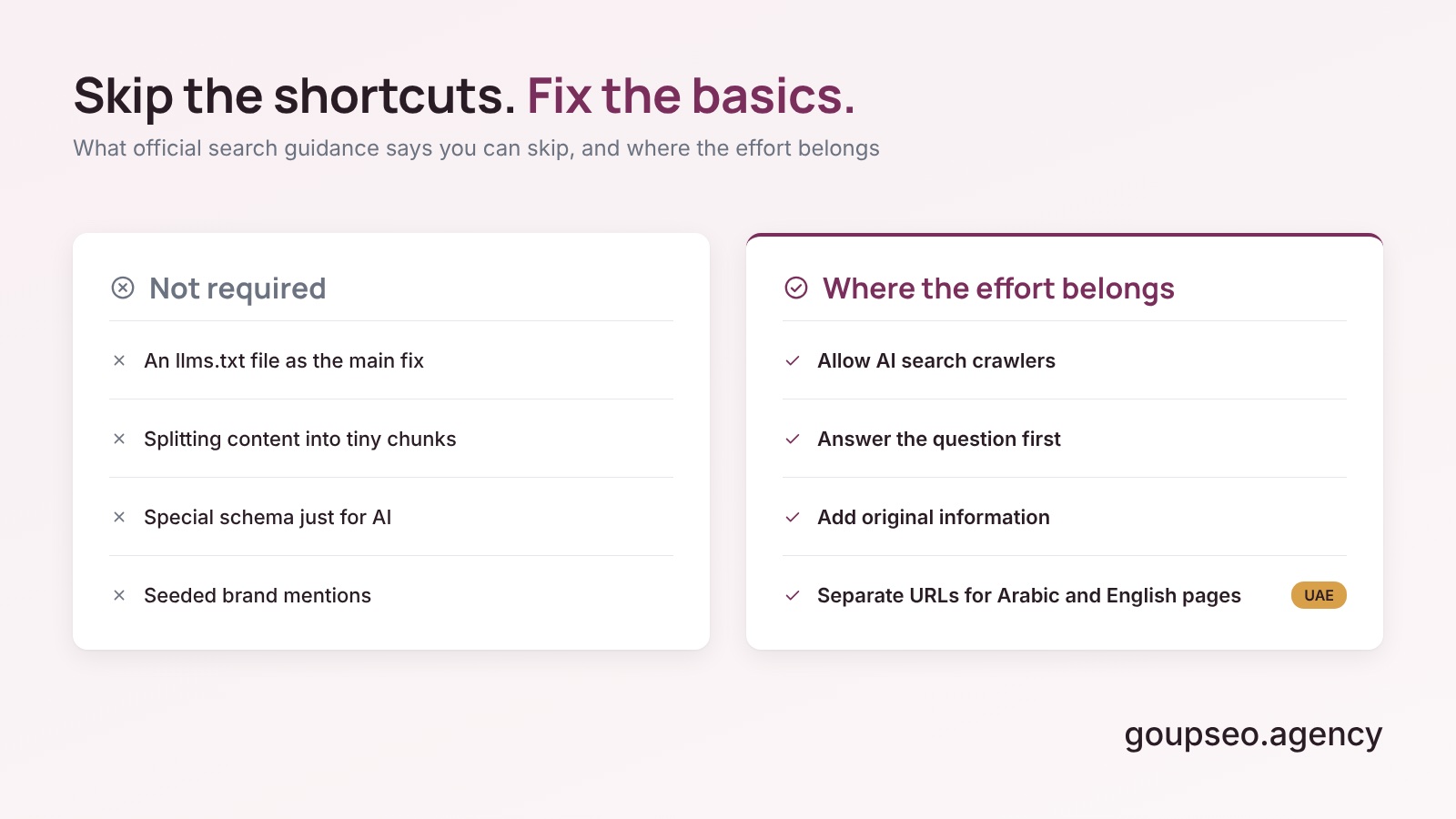
Google's generative AI guide says you do not need llms.txt files, content chunking, special schema or a special writing style to appear in its AI features. Many LLM optimisation checklists still lead with these items. So do some AI answers, including Google's own.
Google announced the guide on 15 May 2026. "We hope this guide provides more clarity to help you continue to create great content," John Mueller of Google Search wrote in the announcement.
On 23 November 2026, we searched "how to optimize content for llms" on google.ae. The Google AI Overview advised breaking pages into modular blocks and adding FAQPage or HowTo schema. Google's own documentation says neither is required.
| What checklists and AI answers say | What Google's guide says |
|---|---|
| Add an llms.txt or other AI text file | No new machine-readable files, AI text files, markup or Markdown are needed |
| Break content into small chunks | There is no requirement to break content into tiny pieces |
| Add special schema for AI | Structured data is not required, and there is no special schema.org markup to add |
| Seed brand mentions | Inauthentic mentions "aren't as helpful as it might seem" |
Source: Google Search Central, Optimizing your website for generative AI features on Google Search, updated 10 July 2026.
llms.txt is a proposed Markdown file that lists a site's key pages for AI tools to read. Jeremy Howard, co-founder of Answer.AI, proposed it in September 2024. "Context windows, while larger than they were, are still too small for most websites in their entirety," Howard wrote. The llms.txt page still calls it a proposal open for community input.
We are not against llms.txt. GoupSEO published one for a new B2B SaaS client in Germany, alongside question-led pages, and that case study says no single tactic can be credited. We treat llms.txt as a cheap extra for tools other than Google, never as the fix.
One limit: Google's list covers only Google. OpenAI, Perplexity and Anthropic have published no equivalent list in the sources we checked.
Which content changes does research link to AI citations?
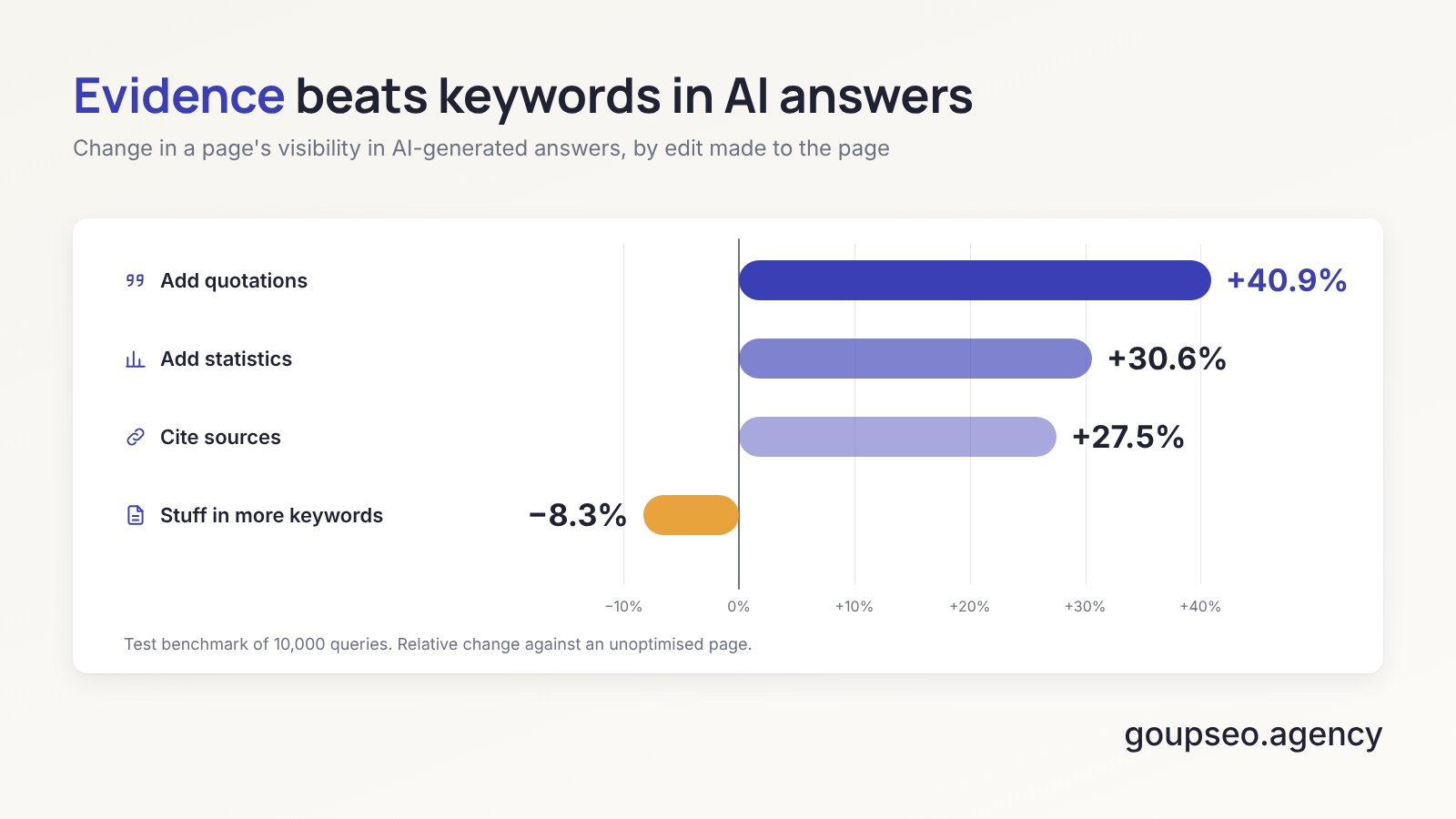
The best-known study on this question found that adding quotations, statistics and source citations raised a page's visibility in AI-generated answers, while keyword stuffing lowered it. It used a test benchmark, not live business sites, so read it as a direction.
The study, "GEO: Generative Engine Optimization" by Pranjal Aggarwal and colleagues, was accepted to KDD 2024, the ACM conference on knowledge discovery and data mining. Aggarwal and colleagues built GEO-bench, a set of 10,000 queries, and found that GEO methods can boost visibility by up to 40% in generative engine responses.
| Change to the page | Change in visibility |
|---|---|
| Add quotations from credible sources | +40.9% |
| Add statistics instead of vague claims | +30.6% |
| Cite relevant sources | +27.5% |
| Add more keywords (keyword stuffing) | −8.3% |
Source: GoupSEO calculation from Table 1 of Aggarwal et al. (KDD 2024), position-adjusted word count, relative to the unoptimised baseline.
Lower-ranked pages gained the most. In the same paper, the Cite Sources method raised visibility by 115.1% for websites ranked fifth in search results. That matters for a UAE business on page one but not at the top.
How to write LLM-friendly content, section by section
LLM-friendly content is content where any single passage can be lifted out and still quoted correctly. Google's guide describes query fan-out as "a set of concurrent, related queries generated by the model". One AI answer can therefore draw on several pages, each covering part of the question.
LLM content optimisation means each section must make sense on its own. These are the rules we apply in GoupSEO content work:
- Answer first. Put a one or two sentence answer directly under each heading, then the detail.
- Name things. Write "Google AI Overviews" and "your Dubai Marina clinic", not "it" or "the tool". A lifted passage loses the paragraph before it.
- Define each term once, in one clean sentence.
- Back claims with sources, figures and quotes, the three changes the GEO study tested.
- Add what only you know. Google's people-first guidance asks whether content provides original information, reporting, research, or analysis.
- Show who wrote it. The same Google guidance strongly encourages accurate authorship information, such as bylines.
The hard part is the fifth rule. Structure is easy to copy. Your own figures, cases and local knowledge are not, and Google's guide warns against recycling what others have already said.
Why Arabic and English pages matter for LLM SEO in the UAE
In the UAE, most people aged 15 to 64 have used generative AI, and Google's AI features work in English and Arabic. An English-only site gives AI answers nothing of yours to cite for an Arabic question.
Microsoft measures the share of people aged 15 to 64 who have used a generative AI product. Microsoft's September 2026 report put UAE usage at 73.3% in the second quarter of 2026, top of Microsoft's leaderboard, against 18.8% of the working-age population worldwide.
As of 23 November 2026, Google's AI Overviews help page lists the UAE and Arabic. Google's AI Mode help page lists the UAE and Arabic too.
Google recommends different URLs for each language version of a page, connected with hreflang, a tag that tells Google which language each version is in. Google advises against switching the language with cookies or browser settings on a single URL.
GoupSEO's 12-month engagement with a Dubai business setup consultancy that doubled organic traffic is a working example. GoupSEO built pages in Arabic, Spanish, German, Russian and other languages to reach founders that English-only competitors missed. Leads tripled, and citations in ChatGPT, Gemini and Claude rose 1.5x. The case study labels the citation figure directional, because citation counts are harder to verify than search data.
How do you measure AI content optimisation?
You can measure part of AI content optimisation with free tools. Google Search Console reports how often your pages appear in Google's AI features, and Bing Webmaster Tools reports Microsoft Copilot citations. Neither shows which prompts name your brand, so you also need a manual prompt log.
Google introduced Generative AI performance reports in Search Console on 3 June 2026, and rolled them out to all websites worldwide by 31 August 2026. The reports show impressions in AI Overviews, AI Mode and Discover by page, country, device and date. Google's announcement does not mention clicks or queries.
Microsoft's AI Performance report in Bing Webmaster Tools, in public preview since 10 February 2026, shows citations, cited pages and grounding queries. Grounding queries are the searches an AI system ran to find the page it cited.
| Tool | Surfaces covered | What it reports | Limit |
|---|---|---|---|
| Search Console, Generative AI report | AI Overviews, AI Mode, Discover | Impressions by page, country, device, date | No clicks or queries in Google's announcement |
| Bing Webmaster Tools, AI Performance | Copilot, Bing AI summaries, select partners | Citations, cited pages, grounding queries | Grounding queries are a sample |
| Manual prompt log | ChatGPT, Gemini, Perplexity, Claude | Who is named and which page is cited | No volume or traffic |
Source: Google Search Central Blog, June 2026; Bing Webmaster Blog, February 2026.
GoupSEO's work with a new B2B SaaS company in Germany shows what this data looks like. In three months, the GoupSEO client reached 100K GenAI impressions in Search Console and 2,000+ organic clicks per month. The case study calls the AI figures proxies, because no tool reports citations for each prompt.
Google's guide also says no third-party tool has access to Google's internal ranking or AI systems. More results by client type are in GoupSEO's SEO and AI search case studies.
A Monday-morning LLM optimisation checklist
Start with access and measurement, then content. A marketing lead can brief each step this week.
- Check robots.txt, CDN and firewall rules for OAI-SearchBot, PerplexityBot and Claude-SearchBot.
- Confirm key pages are indexed and allowed a snippet in Google Search. Google says nosnippet, data-nosnippet and max-snippet limit what its AI features show, so check where those tags are used.
- Open the Generative AI report in Search Console, and add your site to Bing Webmaster Tools.
- Write down 10 to 20 buying questions. Run them monthly in ChatGPT, Gemini, Perplexity and Google, and log who is named.
- Rewrite the first two sentences of each service page so they answer the main question.
- Add one sourced figure or quote to each key section.
- Publish Arabic pages on their own URLs for the services your customers search for in Arabic.
- Skip the shortcuts Google rules out, such as special AI schema.
For sector-specific AI search work, see the industries GoupSEO works with.
AI search features change quickly, often from one month to the next. We last verified every platform claim in this article on 23 November 2026.
Frequently asked questions
Do you need an llms.txt file to appear in AI search?
Not for Google. Google's generative AI guide says you need no new machine-readable files, AI text files, markup or Markdown to appear in Google Search. llms.txt is still a proposal, so treat it as an optional, low-cost extra for other AI tools rather than a requirement.
Does schema markup help LLMs cite your content?
Not for Google's AI features. Google says structured data is not required for generative AI search, and there is no special schema.org markup to add. Where you use structured data, it should match the text visitors see on the page.
Which AI crawlers should a UAE business allow?
For visibility in AI answers, allow the search crawlers: OAI-SearchBot for ChatGPT search, PerplexityBot and Claude-SearchBot, plus Google's normal crawling. Training crawlers such as GPTBot and ClaudeBot are a separate decision.
How long does it take AI answers to reflect a change?
Crawler access changes are the fastest. OpenAI says ChatGPT search adjusts about 24 hours after a robots.txt update, and Perplexity says changes may take up to a day. Content changes take longer, because the page must be crawled again first.
Is LLM optimisation different from SEO?
Mostly not. Google says optimising for its generative AI search is still SEO. The difference is the goal. LLM optimisation aims for your brand to be named and cited inside an AI-written answer, so it adds citation tracking and prompt tests to classic SEO.