What is topical authority, and does Google actually measure it?
Google does not measure topical authority as a single score. It is a practitioner's name for how strongly search engines and AI systems link your site to one subject, based on coverage and trusted backing. Google has described a topic authority system for news, and has published nothing similar for business websites.
In May 2023, Google explained how its news topic authority system works. The system looks at how notable a publication is for a topic or location, whether others cite its original reporting, and its reputation. It was built for news queries. Google's guide to its search ranking systems, last updated in December 2025, lists no separate topical authority system for other sites.
That makes topical authority SEO, the search engine optimisation (SEO) work of building subject coverage, a planning idea rather than a number to chase. The nearest Google equivalent is in its helpful content guidance. Google's guidance asks whether your site has a primary purpose or focus, and whether you publish lots of content on many different topics.
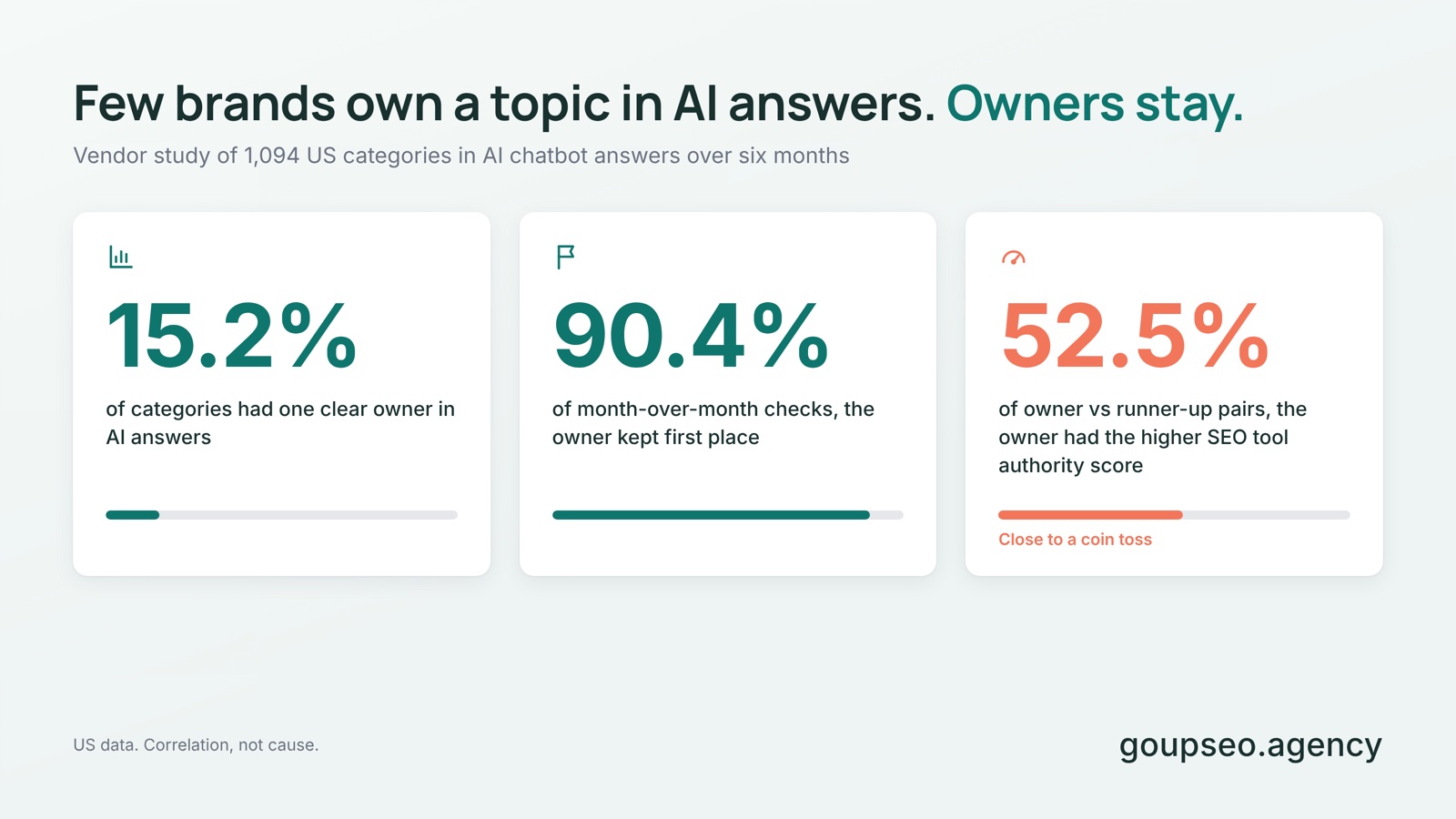
Topical authority is also not domain authority, a tool score that mostly reflects links to the whole site. In a July 2026 Semrush vendor study of US ChatGPT answers, topic owners beat their runner-up on Semrush Authority Score in only 52.5% of pairs.
Why does topical authority matter more for AI search?
Topical authority matters more in AI search because AI answer engines build each response from several retrieved passages, often across subtopics. A site that covers the whole subject has more pages to retrieve. A brand that keeps appearing becomes the default name in the answer.
Generative Engine Optimisation (GEO) and Answer Engine Optimisation (AEO), the work of getting cited in AI answers, both start here.
Google says both AI Overviews and AI Mode may use a query fan-out technique, running several related searches across subtopics and data sources before writing the answer. When Google launched AI Mode in May 2025, Elizabeth Reid, VP and Head of Search at Google, described the technique as "breaking down your question into subtopics".
Each subtopic is a separate chance to be retrieved. If your site answers only the main question, the fan-out searches find someone else.
In vendor research, Semrush and the Growth Memo newsletter tracked 1,094 US categories in ChatGPT from January to June 2026, and only 15.2% of those categories had a clear owner. Where a clear owner existed, it kept first place in 90.4% of month-over-month comparisons. This is US ChatGPT data and shows correlation, not cause. We found no comparable dataset for the UAE.
In a September 2025 study, University of Toronto researchers found a systematic bias toward earned media in AI search. Earned media means third-party sources such as reviews and independent publications, as opposed to brand-owned content. Your own cluster is half of topical authority. What independent sites say about you is the other half, and our AI SEO services in Dubai work on both.
How to build topical authority: a six-step framework
To build topical authority, pick one subject you can own and map every question buyers ask about it. Answer each question on its own page, link the pages into a cluster, make your brand consistent across the web, and keep AI search crawlers allowed. Coverage alone is not enough. Links and mentions do the rest.
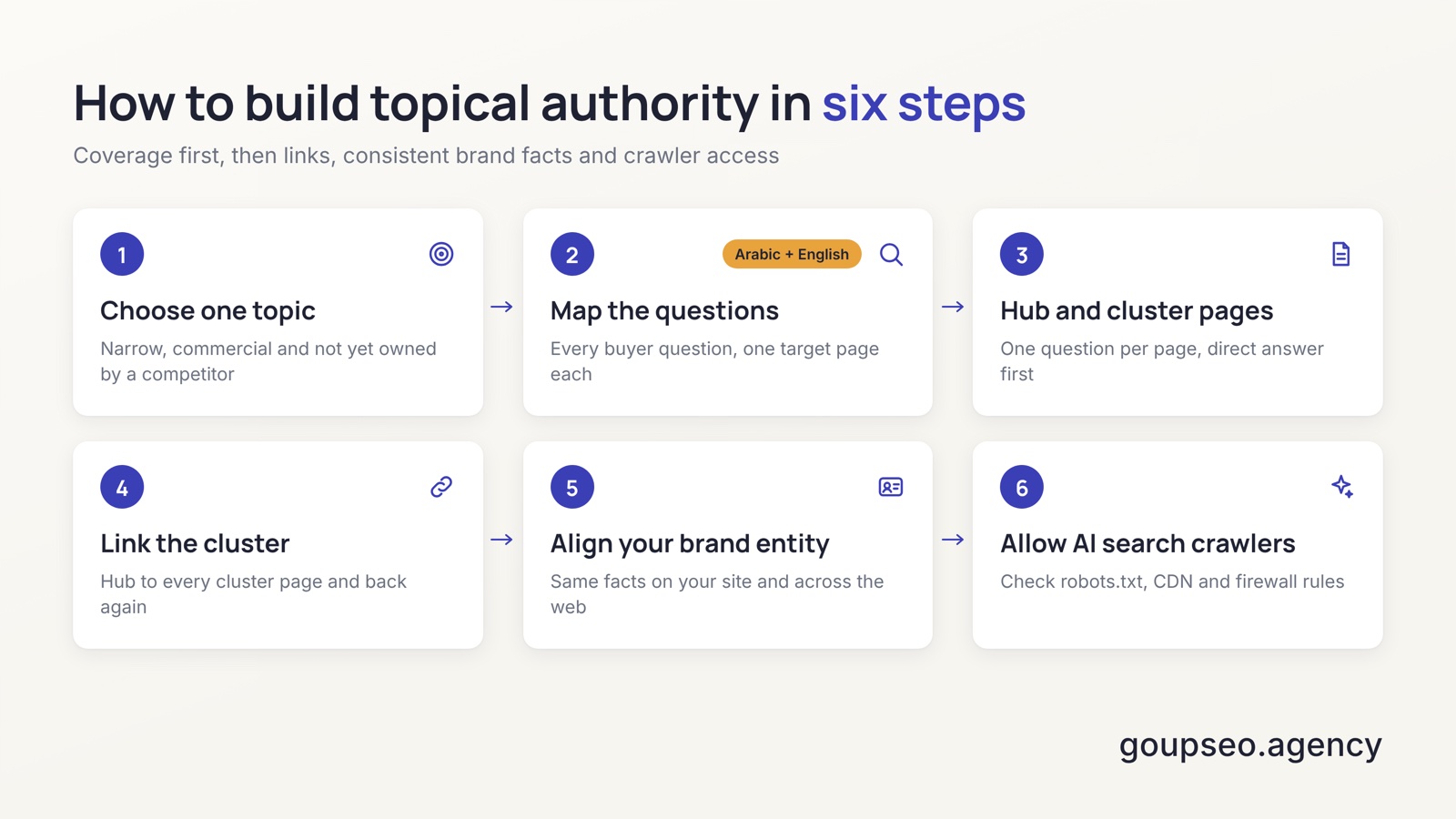
1. Choose one topic you can own
Choose a topic where you have real delivery experience, where buyers have commercial intent, and where no competitor already dominates. Narrow beats broad. "Corporate tax registration for Dubai free zone companies" is a topic an accounting firm can own, and the kind of cluster our accounting firm SEO services in Dubai would plan. "Finance" is not.
If you serve several sectors, give each sector its own cluster rather than one blended blog. GoupSEO organises its own site this way, with the industries GoupSEO works with grouped by sector.
2. Build a topical map from real questions, in Arabic and English
A topical map is a list of every question in your topic, grouped by intent, with one target page for each. Pull the questions from People Also Ask on google.ae, sales calls, WhatsApp enquiries and the follow-up questions AI engines suggest.
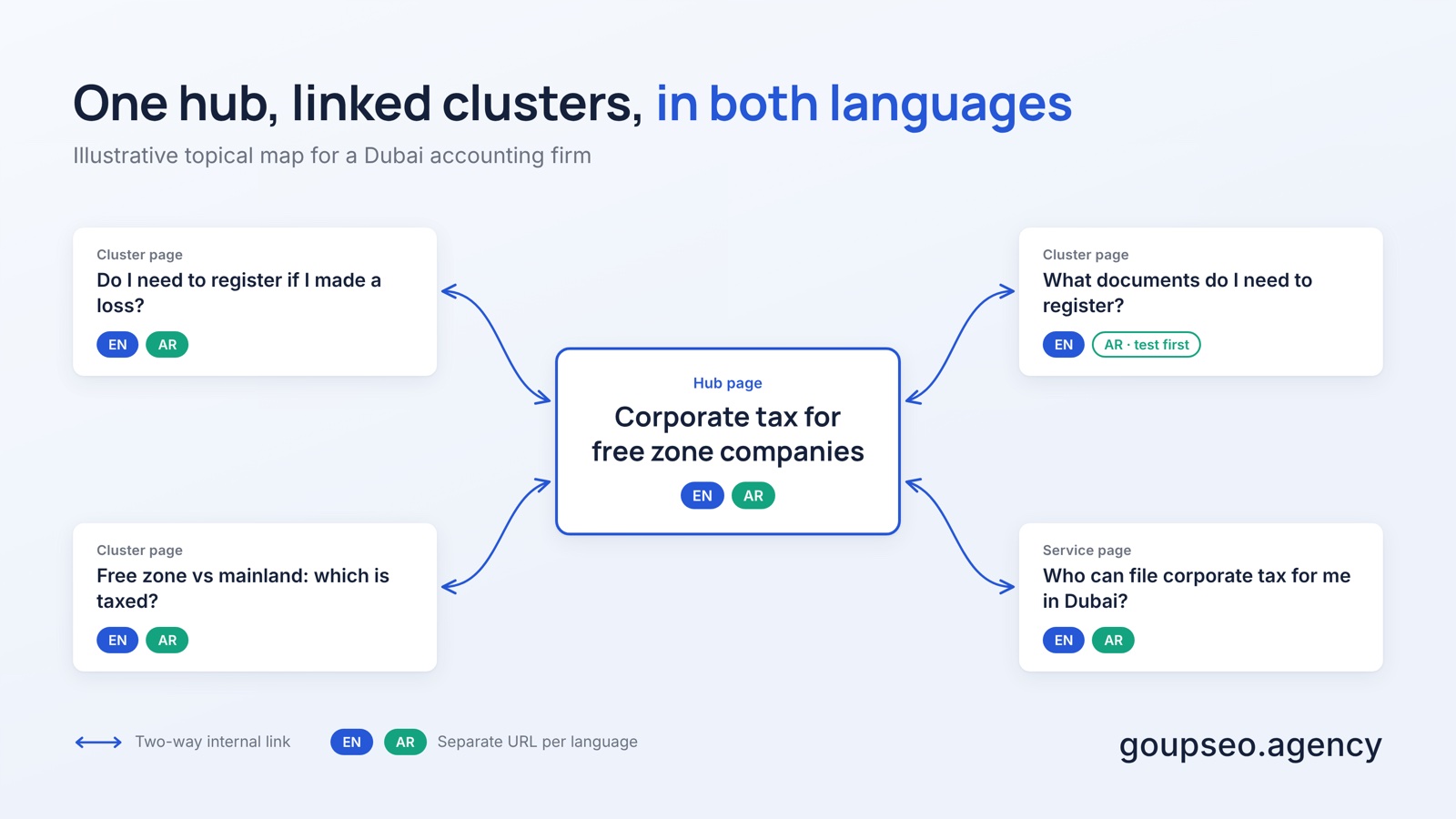
| Question (illustrative) | Intent | Page type | Arabic page? |
|---|---|---|---|
| What is corporate tax for free zone companies? | Learn | Hub page | Yes |
| Do I need to register if I made a loss? | Check | Cluster page | Yes |
| Free zone vs mainland: which is taxed? | Compare | Cluster page | Yes |
| What documents do I need to register? | Do | Cluster page | Test first |
| Who can file corporate tax for me in Dubai? | Hire | Service page | Yes |
Illustrative example of a topical map for an accounting firm. The questions are examples, not tax guidance.
3. Publish a hub page and cluster pages that answer first
A hub page, also called a pillar page, covers the topic broadly and links to every cluster page. A cluster page answers one question fully, with the direct answer in its first two sentences. Together they form a topic cluster.
Google's helpful content guidance asks whether your content clearly demonstrates first-hand expertise and a depth of knowledge. A page that restates what ten other pages say gives an AI engine no reason to cite you. Add what only you know: your process, your numbers and your local constraints.
4. Link the cluster so the structure is visible
Google uses links as a signal when determining the relevancy of pages and to find new pages to crawl. Google also says every page you care about should have a link from at least one other page on your site.
- Link the hub page to every cluster page in the body copy, as well as in menus.
- Link each cluster page back to the hub page.
- Link sibling pages where a reader would naturally go next.
- Use descriptive anchor text that names the destination's topic.
5. Make your brand entity consistent on and off your site
Entity SEO is the work of making search engines and AI models recognise your brand as one clearly defined thing, with consistent facts attached to it. Use the same brand name, description, founder and service list on your site, Google Business Profile, LinkedIn and directories.
Google says Organization structured data can help it disambiguate your organisation in search results. The markup's sameAs property lets you point to your profiles on other websites. Then earn mentions where your buyers read: UAE trade press, industry associations and partner sites.
6. Keep AI search crawlers allowed
AI search engines can only cite pages they can fetch. OpenAI says OAI-SearchBot surfaces websites in ChatGPT's search features, and sites that block it will not be shown in ChatGPT search answers, apart from plain navigational links. GPTBot is a separate crawler used for training, so blocking GPTBot is a different decision.
Perplexity says PerplexityBot surfaces and links websites in Perplexity search results and is not used to train AI models. Blocks can sit in your content delivery network (CDN) or firewall settings as well as in robots.txt. Checking each crawler is part of our technical AI SEO services in Dubai.
How does topical authority work for Arabic and English sites in the UAE?
In the UAE, topical authority has to be built in the languages your buyers search in. Google AI Overviews and Google AI Mode both support Arabic. An English-only cluster leaves Arabic questions to competitors, however strong your English pages are.
Google's help pages, checked in November 2026, list the United Arab Emirates as a supported country for both AI Overviews in Google Search and AI Mode in Google Search. Both pages also list Arabic as a supported language.
Google uses the visible content of a page to decide its language, not the lang attribute or the URL, and it recommends a separate URL for each language version. Translating only the menus and buttons while the body stays in English does not make an Arabic page.
Give each Arabic cluster page its own URL, translated in full. Connect the language versions with hreflang annotations, code that tells Google which page is the other language version. Not every page needs an Arabic twin. Start with the questions your Arabic-speaking buyers actually ask.
What looks like topical authority but is not?
Three tactics look like topical authority and are not: mass-producing pages, adding schema and expecting citations, and appearing once in many topics instead of repeatedly in a few. Each one wastes budget, and the first can also cost you rankings.
Mass-produced pages. Google's spam policies define scaled content abuse as generating many pages mainly to manipulate rankings rather than help users, however the pages are made. Using generative AI tools to produce many pages without adding value is one of Google's own examples.
Schema as a shortcut. Google states that there is no special schema.org structured data you need to add to appear in AI Overviews or AI Mode. Schema helps Google read facts you already show. It does not create authority. When we tested Perplexity on 23 November 2026, its answer for Dubai businesses still recommended schema types as a citation lever.
Spreading thin. In August 2026, the SEO tool vendor Semrush published a follow-up on the same US ChatGPT data. Appearing in only one of five prompts in a category went with a lower share of brand mentions. The penalty disappeared only once a brand appeared in at least three of five prompts. Citations spread more easily than mentions.
| Being cited | Being named | |
|---|---|---|
| What it means | Your page is a source link | Your brand appears in the answer text |
| What builds it | Useful, crawlable pages | Repeated presence across a topic |
| How to check | Source links in the answer | Your brand name in the answer |
How long does topical authority take, and how do you measure it?
Expect months, not weeks. No platform publishes a timeline, so measure progress directly. Track the whole cluster in Search Console, run the same prompts in AI engines each month, and check whether your brand gets named in the answer, not just linked.
Google says traffic from AI Overviews and AI Mode is reported in the Search Console Performance report within the Web search type, together with regular results. Filter by your cluster's URLs and watch impressions across the whole cluster, not one page.
For AI answers, use a fixed prompt set and repeat it monthly. This prompt-visibility tracking is part of our GEO and AEO services.
| Prompt type | Example | Engines | Record |
|---|---|---|---|
| Definition | What is free zone corporate tax? | ChatGPT, Perplexity, Google AI Mode | Cited? Named? |
| How-to | How do I register for corporate tax? | Same | Cited? Named? |
| Comparison | Free zone vs mainland tax | Same | Competitors named |
| Hire | Best tax consultant in Dubai | Same | Position of your brand |
| Arabic | The same questions in Arabic | Same | Cited? Named? |
In a GoupSEO engagement with a global B2B sales CRM, idle landing pages were reworked first. A content engine then covered the topics buyers read about, and internal links carried that value to the pages that sell. For this GoupSEO client, organic traffic rose from 12K to 35K in 1.5 years. That is a classic search result rather than an AI citation figure, and the client was not in the UAE.
You can see verified results for universities, retailers and SaaS brands in GoupSEO case studies.
AI search features change quickly. The platform claims in this article were last verified on 23 November 2026.
Want help building topical authority in the UAE?
Our AI SEO strategy consulting in Dubai begins with an audit and prompt research. It then maps the topic clusters and entity fixes your site needs, in the order that moves revenue first. Raaquib Pathan, GoupSEO's founder, works on every engagement directly, and there are no lock-in contracts. To see where your brand stands in Google AI Overviews and ChatGPT today, Get a Free AI Visibility Audit.
Frequently asked questions
How many articles do I need to build topical authority?
There is no fixed number. Cover every real question in one topic, one page per question, and stop when the questions run out. Google's helpful content guidance warns against lots of content on many different topics. A short, complete cluster on one subject is safer than a long blog that drifts.
Do I need schema markup to appear in Google AI Overviews?
No. Google states that no special schema.org structured data is required to appear in AI Overviews or AI Mode. Pages need to be indexed and eligible to show a snippet. Organization markup still helps Google disambiguate your brand, so add it, but treat it as support for content and mentions, not a replacement.
Can I use AI tools to write my topic cluster?
You can use AI tools in the process, but not to mass-produce pages. Google's scaled content abuse policy covers many pages generated without adding value for users, however they are made. Each cluster page needs something an AI engine cannot find elsewhere, such as your own process or data.
Is topical authority the same as domain authority?
No. Domain authority is a score that SEO tools estimate, mostly from links to the whole site. In Semrush's July 2026 vendor study of US ChatGPT answers, topic owners beat their runner-up on Authority Score in only 52.5% of pairs. A high domain score does not mean you own a topic.